
Last updated September 10, 2026
Full 25-point door and opener safety check with every visit - springs, cables, rollers, tracks, and your LiftMaster or Chamberlain opener included
You get a price before we start. It does not change when the truck arrives.

 Before
 After
After Before
 After
After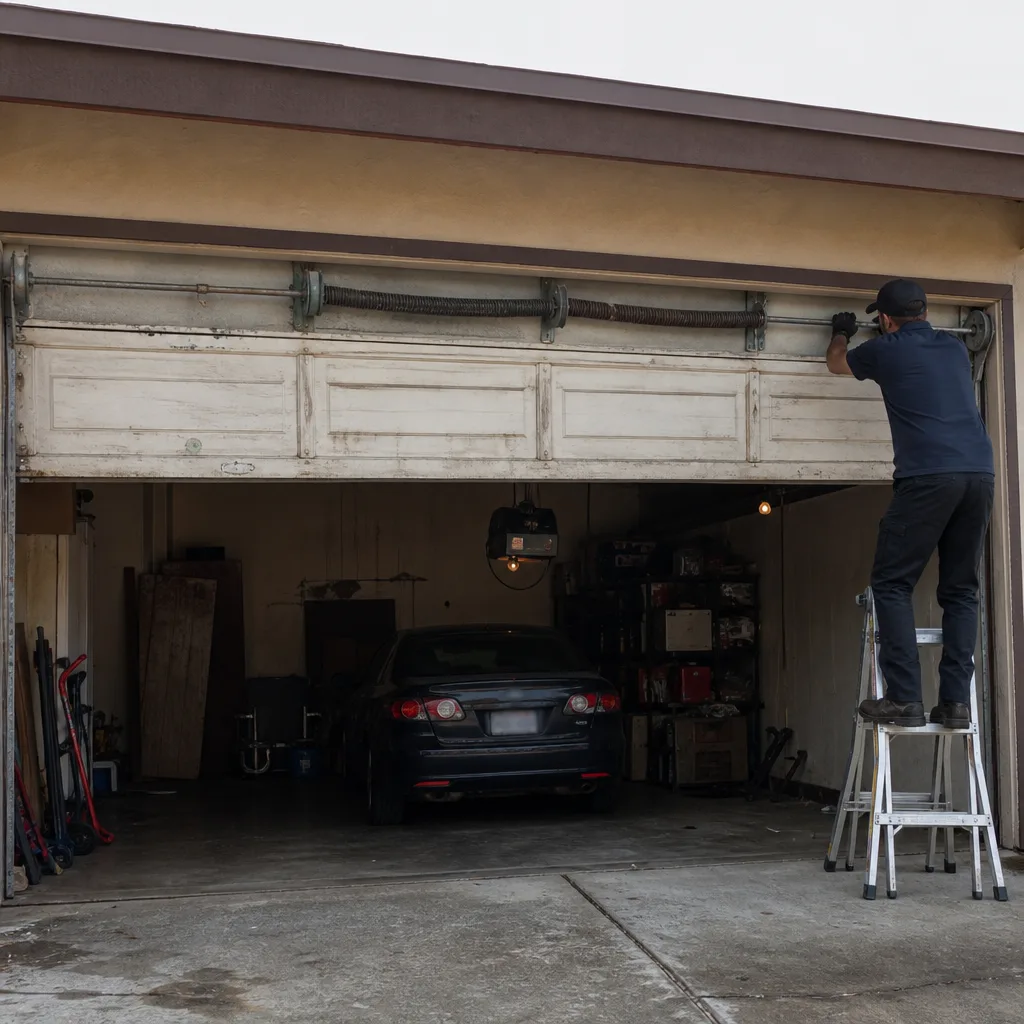 Before
 After
AfterGarage Door Repair Maintenance Checklist for Poway Homeowners
Most garage door checklists read like they were written for a house in Ohio. They tell you to check the weather seal in October, lubricate in April, and assume winter means snow. Poway doesn’t work that way. We don’t get snow, we get Santa Ana winds that whip down from the mountains in October and November. We get marine layer moisture that creeps in from the coast in June when inland temperatures spike and the air turns heavy. We get granite dust, not road salt. A door that survives a Minneapolis winter without complaint will eat its own cables in a Poway October if nobody’s been watching. Otto has replaced more cables in November than any other month. Not because November is unlucky. Because the temperature swings after Santa Ana season stress metal that was already fatigued from a long, dry summer. A generic quarterly checklist won’t catch that.
Quick Answer
Poway homeowners should follow a month-by-month garage door maintenance routine tied to the city’s actual climate events: test balance monthly, lubricate the three critical points with a lithium-based grease in spring and fall, inspect cables and springs weekly during Santa Ana season, and keep a written log of every service date. This prevents the two most common Poway failures: cable snap in late fall and motor burnout in summer when the door runs out of balance and the opener strains against it.
Table of Contents
- The Six-Point Monthly Balance Test That Takes Five Minutes
- The Poway Seasonal Calendar: What Breaks When, and Why
- Lubrication: The Three Points That Matter, the Product That Works, the Ones That Don’t
- The Noise-to-Problem Decoder: Grind, Pop, or Squeak
- Cable and Spring Inspection: What to Look For Before October
- The Documentation Habit: Why a Service Log Protects Your Warranty and Your Resale Price
- Common Mistakes to Avoid
- When to Call a Professional
The Six-Point Monthly Balance Test That Takes Five Minutes
A garage door is 200 pounds riding on two springs. Respect it. When the springs are balanced, the door should hold itself at the halfway point without drifting up or sliding down. When the balance is off, the opener motor has to work harder every single time the door moves. That’s not a metaphor. An unbalanced door can cut the life of your opener motor in half, because the motor is doing the job the springs are supposed to do. In Poway, where garages are often the primary entry point and doors cycle three to five times a day, that adds up fast.
Here is the six-point test. It takes five minutes and you don’t need any tools except your own hands and eyes.
- Pull the release handle. Disconnect the door from the opener using the red emergency release cord. The door should be in the closed position when you do this.
- Lift the door by hand to waist height. It should lift smoothly without fighting you. If it feels like a hundred-pound dead weight, the springs are not doing their job.
- Let go at waist height. The door should stay right where you left it. Drifting up means the springs are over-tightened. Drifting down means they’re tired.
- Lift the door all the way up. At the top, it should settle gently into the horizontal track without slamming. If it slams, the springs are too hot.
- Bring the door halfway down. It should stay. Drop it from knee height. It should close with a controlled thud, not a crash.
- Reconnect the opener. Run the door through a full open-close cycle and listen. The motor should hum evenly, not strain. If it grunts at the start of travel, the balance is off and you’re hearing the motor pick up the slack.
If the door fails any of these checks, stop using it until a professional has looked at the springs. Do not adjust the springs yourself. Springs under tension hold enough force to seriously injure you or someone in the garage. We replace springs in Poway garages every week, and the cost of a spring is nothing compared to the cost of a broken finger or a collapsed door. Call Garage Door Repair in Poway and get an on-call quote before anyone touches anything.
The Poway Seasonal Calendar: What Breaks When, and Why
Poway sits inland enough to get real heat, close enough to the coast to get marine layer moisture, and squarely in the path of the Santa Ana winds every fall. Each of those conditions produces a different failure mode in a garage door. Here is what we see at different points in the year, month by month.
January – February: The Cool, Damp Months
Winter in Poway is mild but moist. Morning fog off the coast leaves condensation on metal components, especially in garages that are not climate controlled. This is when we see the first rust blooms on torsion springs and track hardware. Rust is not a cosmetic problem. A rusted spring develops micro-pitting that concentrates stress and eventually becomes a snap. If you see orange streaking on your springs, schedule a lubrication at minimum, and expect a replacement conversation within a year or two. For Garage Door Warning Signs: A Poway Homeowner’s Reference Guide, see our detailed breakdown.
March – May: The Dry, Grinding Months
Spring in Poway is essentially early summer. Rain stops, humidity drops, and the air fills with granite dust and pollen from the hills. This is a cutting compound for moving parts. Every hinge, roller, and bearing point is grinding fine dust into the metal. Lubricate in March, before the heat peaks. Use a lithium-based grease, not a spray lubricant, and apply it to the three points we list in the lubrication section below. This is also the right time to check the weather seal along the bottom of the door. Poway’s dry spring cracks rubber faster than moist climates do.
June – August: The Heat That Burns Out Motors
Summer is when we replace the most opener motors in Poway. The garage interior can hit 110 degrees or higher. Most opener motors have a thermal overload switch that shuts them down when they overheat. The problem is, a motor that is already working against an unbalanced door will hit that thermal limit much faster. We’ve replaced opener motors in July where the root cause was not the motor at all. It was a tired spring that the motor had been compensating for since January. If your opener shuts off mid-cycle and will not restart for 10 to 15 minutes, that is the thermal switch doing its job. The fix is not a new motor. The fix is balancing the door so the motor stops cooking itself.
September – November: Santa Ana Season, the Cable Killer
This is the most dangerous window for Poway garage doors, and the time when our service calls spike. Santa Ana winds bring hot, dry air that drops relative humidity into single digits. Metal contracts. Then the wind stops, the marine layer rolls back in, and the moisture returns. Metal expands. Repeat this cycle several times over a few weeks and you have thermal fatigue concentrated exactly where the cable wraps around the drum and where the spring coils sit. This is why Otto has replaced more cables in November than any other month. The cable itself is usually fine in June. In November, after a month of expansion and contraction, the wire strands start to fray. Some snap outright. If your door sits in an exposed garage or faces east where the morning sun hits the springs directly, the stress is even worse. Inspect cables and springs weekly from September through Thanksgiving. Look for frayed wire strands, gaps in the coils, or cables that are not seated neatly in the drum grooves.
December: The Cleanup Month
After Santa Ana season winds down, do a full reset. Clean the tracks with a dry rag, re-check balance, re-lubricate, and log everything in your service book. This is also a good time to inspect for any rust that started during the November moisture swings and address it before January’s fog cycle begins again.
Lubrication: The Three Points That Matter, the Product That Works, the Ones That Don’t
Most homeowners over-lubricate the wrong things and under-lubricate the right ones. A garage door has hundreds of moving surfaces, but only three lubrication points actually matter for keeping the door healthy. Everything else is either sealed, self-lubricating, or should stay dry.
The three points that matter:
- The spring coils. Whether torsion or extension, the spring is the single most important thing to keep lubricated. When coils rub together dry, they abrade. Abraded metal loses cross-section. Lost cross-section means a spring that has less strength than its cycle rating, and a spring that fails early. Oil the coils so they can flex against each other without grinding.
- The roller bearings. Modern nylon rollers have sealed ball bearings that do not need lubrication and can be damaged by it. Older steel rollers without sealed bearings need a drop of oil at the axle where the wheel meets the stem. If your rollers are ten years old and still metal, it is time to replace them with nylon instead of oiling them. Nylon rollers run quieter and do not eat the track.
- The hinges and pivot points. Each hinge pin is a bearing surface. A single drop of oil on each hinge point, two to three times per year, keeps the door from squeaking and keeps the metal from grinding where the panels fold.
The product matters more than most people realize. Use a lithium-based white grease or a garage-door-specific lubricant. These are available at any hardware store in Poway. Apply sparingly. You are not painting the door, you are coating the wear surfaces. A thin film is enough. Wipe off the excess.
The products that do more harm than good:
- WD-40. This is a penetrating solvent, not a lubricant. It will strip the existing grease off your springs and leave the metal bare. Actually accelerates wear rather than preventing it.
- Motor oil. Too heavy. It attracts dirt and dust, which forms a grinding paste on the very surfaces you are trying to protect.
- Graphite spray. Made for locks, not springs. It does not stay where you need it on a moving coil.
- Cooking spray. Do not. Just do not.
The Noise-to-Problem Decoder: Grind, Pop, or Squeak
Your garage door talks. It makes different noises for different problems, and learning to read those noises tells you whether to keep using the door or stop immediately. In our experience, the rule is simple: a squeak is an annoyance, a grind is a countdown, and a pop is a reason to stop.
- Rhythmic squeak, once per panel as the door moves. This is a hinge or roller bearing that has gone dry. The fix is lubrication, and it is not urgent. Keep using the door, but oil the hinges and check the rollers on the next free weekend.
- Constant grinding noise whenever the door moves. This is metal on metal, usually a failed roller bearing or a track that has come out of alignment. The grinding is your door eating itself. Every cycle is doing incremental damage to the track, the roller, or both. This is a call-this-week problem, not a call-next-month problem. The longer it goes, the more likely it turns a $150 roller replacement into a $400 track repair.
- Sharp pop or bang, usually followed by the door refusing to move. This is a spring snap. The pop is the sound of the spring breaking under tension. When this happens, the door is not safe to operate. Do not try to force it. Do not try to open it with the opener. The door is now a dead load and the opener motor is not designed to lift it alone. Call us. A Garage Door Opener in Poway that tries to lift a door with no spring will burn out its gear in seconds.
- Groaning or straining from the opener motor at the start of travel. This is the balance problem we covered earlier. The motor is working against the door’s weight, which means the springs are not pulling their share. Ignore it and you will be replacing the motor in a Poway summer.
- Rattling or clunking in the track area. This is usually loose hardware. Track bolts back out over time, especially on doors that see daily cycling and Poway’s temperature swings. Tighten what is visible, but if the rattle persists, have the track inspected. A loose track can let the door jump the rollers, and that’s a door that comes down on whatever is under it.
Cable and Spring Inspection: What to Look For Before October
The cables and springs are the parts that fail catastrophically. Not gradually. Not with warning. They go from working to broken in a fraction of a second, and when they go, the door follows the wrong way. That’s why the inspection routine is the single most important habit in this whole guide.
Here is what to check, in order:
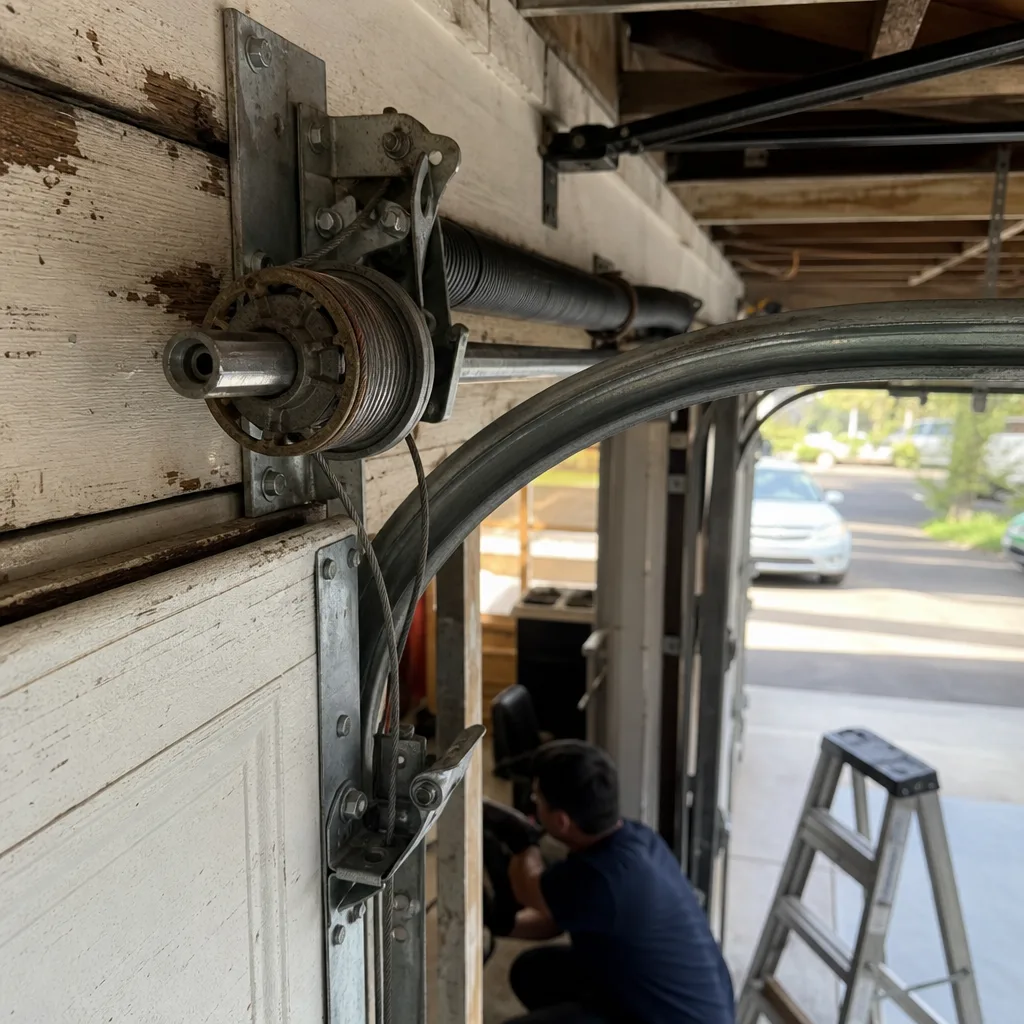
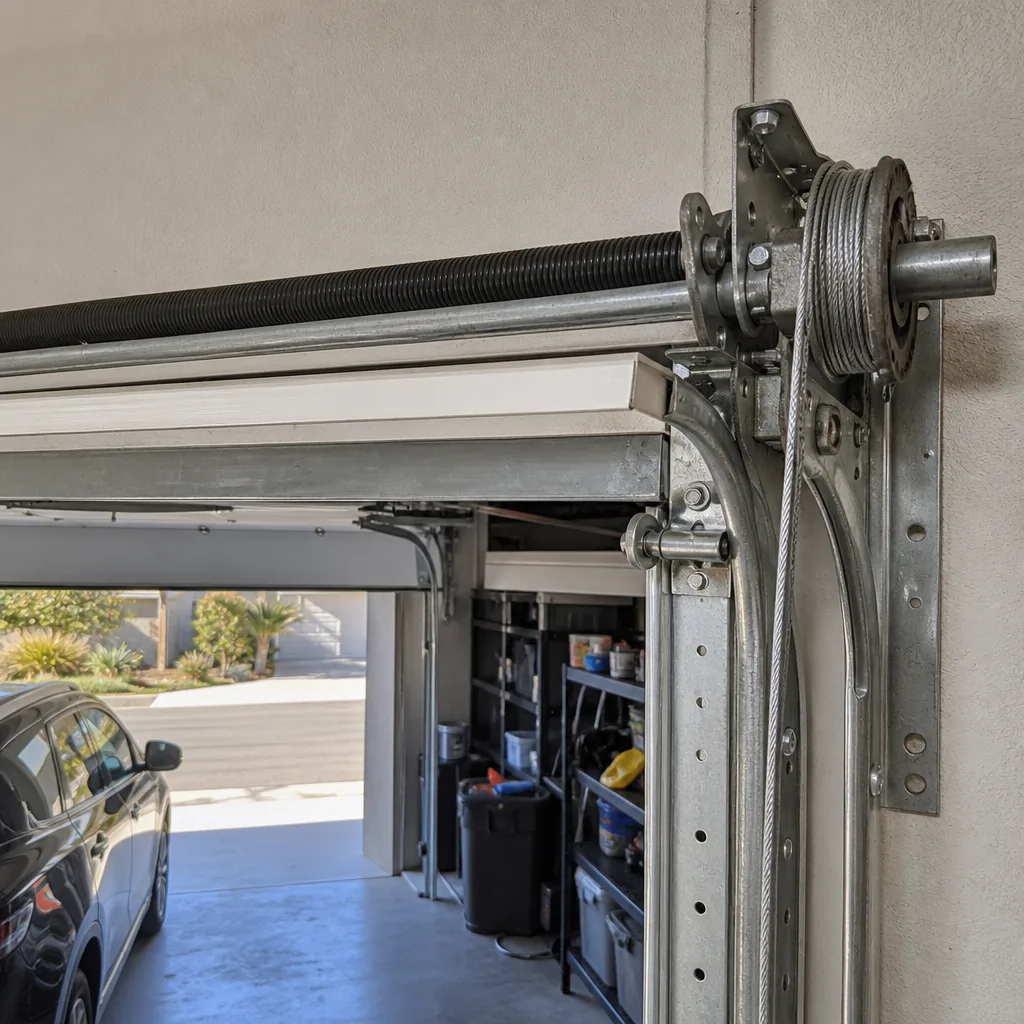
- Look at the cables where they wrap around the drum. The drum is the spool at the top of the track, on either side of the door. The cable should sit flat in the grooves, not overlapping, not riding up on the drum edge. Overlap means the cable is wearing against itself.
- Run your eyes along the exposed cable length. Look for broken wire strands poking out. A cable with even one or two broken strands is compromised. It may hold for weeks, or it may not hold through the next open-close cycle. In Poway, we see cable failures most commonly in November, after the temperature swings have done their work. If you see strands, replace the cable. Do not splice. Do not patch. Replace.
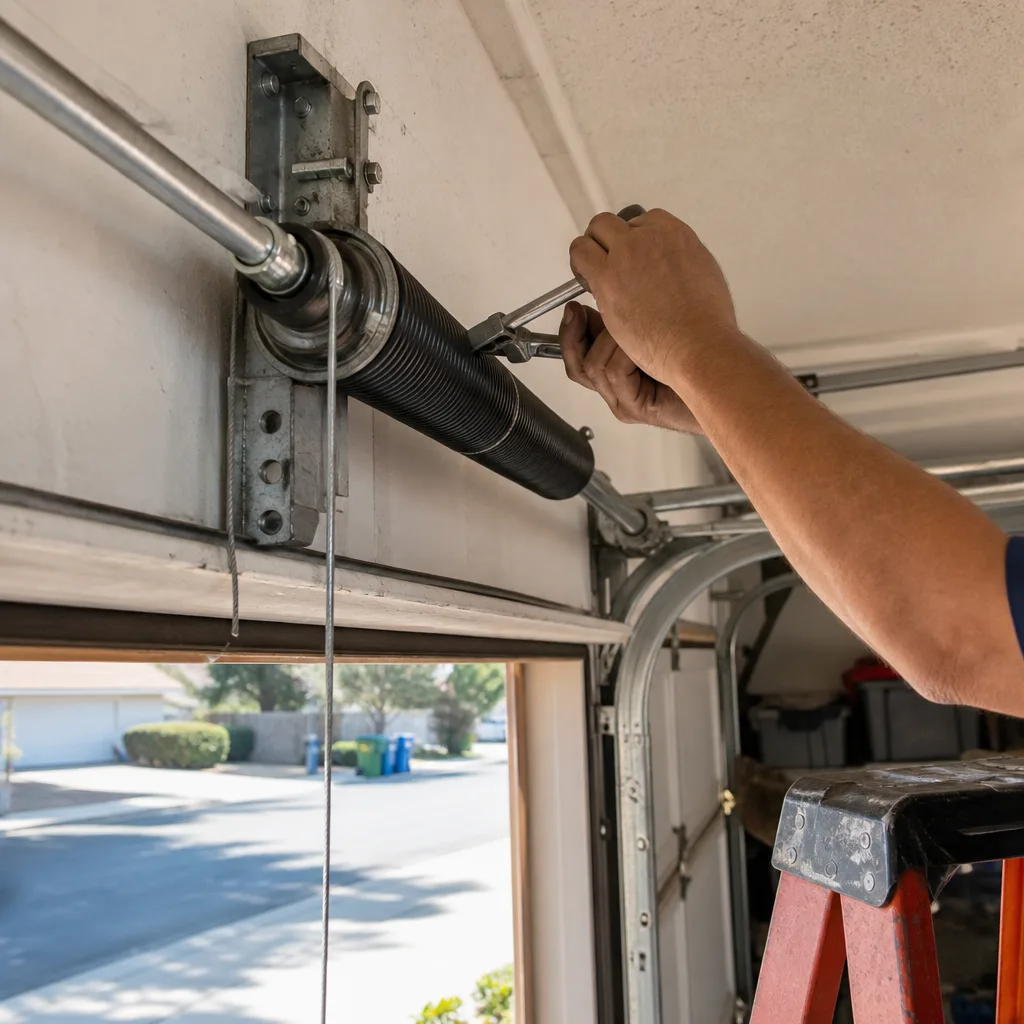
- Inspect the spring coils for gaps. A healthy torsion spring has tight, even coils with no visible gaps. A spring that has started to fatigue will show a small space between coils, often just one or two millimeters wide. That gap is the spring’s way of telling you it has lost tension. It is not going to get better.
- Check for rust streaking. As noted earlier, rust is a stress concentrator. A spring that shows visible rust streaking is a spring that will fail sooner than one that is clean. If the rust is superficial, lubrication can buy some time. If the rust has pitted the metal, the spring’s cycle rating no longer applies.
- Count the cycles. Most Poway garage doors see 3 to 5 cycles per day. At 4 cycles per day, that is 1,460 cycles per year. A standard 10,000-cycle spring lasts about 7 years. A 25,000-cycle spring lasts about 17 years. If your springs are approaching their rated cycle count and you are noticing any of the other warning signs, the smart move is to replace them on your schedule, not on the spring’s schedule.
I count spring cycles the way you count tire miles. I will tell you what’s left on yours. When we inspect a door in Poway, we always count the cycles and give the homeowner an honest estimate of remaining spring life. That’s part of the free estimate, not an upsell.
Extension Spring Safety Note
If your door uses extension springs, the ones that stretch along the horizontal track on either side, they must have a safety cable running through the middle. This cable catches the spring if it snaps, stopping it from flying across the garage. Many older doors in Poway either never had these cables or they were removed at some point. That is a safety hazard. If your extension springs have no safety cable, do not use the door until they are installed.
The Documentation Habit: Why a Service Log Protects Your Warranty and Your Resale Price
Most homeowners throw away their garage door paperwork the day after the service call. Then, two years later, a spring breaks, the original installer says it is not under warranty, and the homeowner has no paper trail to push back. Or worse, they sell the house, and the buyer asks when the door was last serviced, and the answer is a shrug.
Keep a simple log. A spiral notebook in the kitchen drawer is fine. Write down:
- The date of every service call, inspection, or repair.
- The name of the company or person who did the work.
- Which parts were replaced, and their brand. LiftMaster, Chamberlain, Genie, Raynor, whichever it is, write it down.
- The warranty term on each part, in months or years.
- Any cycle count or remaining-life estimate you were given.
- The price you paid, so future quotes have context.
When a buyer asks about the garage door during a Poway home sale, handing them a written service log is a differentiator. It says the house was maintained by someone who paid attention. It protects your negotiating position because the buyer’s inspector will find nothing unexpected. And when a warranty claim comes up, the log is your proof that the door was maintained per the manufacturer’s requirements, which many warranties actually require. The absence of a log is a reason for a claim to be denied. The presence of one is a reason for it to be paid.
We write the 90-Day Done Right Promise on every invoice we leave in Poway. Ninety days in writing. One call brings Otto back, no runaround. The homeowner’s copy goes in the notebook. That’s the start of the log.
Common Mistakes to Avoid
- Treating every month the same. A Poway garage door does not need the same care in August as it does in November. The Santa Ana season is the most dangerous window of the year. A generic quarterly checklist misses that entirely.
- Using WD-40 on the springs. It strips lubrication and leaves the coils bare. Enough said.
- Ignoring the balance test because the door still opens. A door that opens with a straining motor is still opening because the motor is doing the work. The motor is not rated for that job. It will fail early, and the repair bill will be for a spring and an opener instead of just a spring.
- Disconnecting the opener with the door in the up position. When you pull the release handle, the door should be closed, not open. A door released at the top can crash down because there is nothing holding it. This is how we see broken panels and injured fingers. Pull the release only when the door is down.
- Fixing a snapped spring with a YouTube tutorial. We have seen the results. The hospital bill is always more than the spring. Springs are under enough tension to seriously injure you. Leave them to someone trained.
- Ignoring rust because it’s small. Rust is never small. Rust is the beginning of the end for a spring. Catch it early and you replace a part on your schedule. Catch it late and you replace a part when the door is stuck open and the car is inside.
- Not having a service log. Warranty claims and resale negotiations both go badly without paper. Write it down.
When to Call a Professional
Call a professional the moment you notice frayed cable strands, a visible gap in the spring coils, rust pitting, or a door that fails the balance test. Do not wait for the pop. These are not upgrade suggestions, they are warnings. Also call if your opener shuts off mid-cycle, if the door makes a grinding noise that lubrication does not fix, or if you have extension springs without safety cables. Springs, cables, and tracks fall under the same rule: if it fails while the door is moving, someone gets hurt or something gets damaged. Call us for our Garage Door Repair services. We will walk you through an on-call estimate. Otto’s Garage Door offers free estimates in Poway, call (858) 330-1549. We quote the job over the phone and hold that number at the door. If you already have a written estimate from anyone else, bring it. We will give you a free second opinion, no trip charge in our home county.
Frequently Asked Questions
Two times per year, in March and December, using a lithium-based white grease on the spring coils, hinge points, and any unsealed roller bearings. March lubrication prepares the door for the dry, dusty spring and summer months. December lubrication re-coats the metal after Santa Ana season’s expansion and contraction cycles. If your garage is exposed or the door sees more than five cycles per day, add a third lubrication in September.
Spring replacement for a standard two-car garage door in Poway typically runs between $180 and $350 per spring, installed, depending on the spring’s cycle rating and the brand. Higher-cycle springs cost more upfront and last significantly longer. We quote exact numbers over the phone and hold that price when we arrive. Call (858) 330-1549 for a firm quote on your specific door. Estimates are free, and the price never changes between the phone and the driveway.
No, unless you are trained. The cable is connected to a spring under tension, and the procedure for replacing it requires managing that tension safely. A cable that snaps while a door is open can send the door down hard enough to injure someone or crush whatever is under it. Professional replacement is the only safe option. In Poway, we replace cables throughout the year but especially during November, when the Santa Ana temperature swings cause most of the failures we see.
Most opener motors have a thermal overload switch that shuts the motor off when it overheats. In a Poway summer, garage interiors regularly exceed 110 degrees. If the motor is already working against an unbalanced door, it hits the thermal limit much faster. The fix is not a new motor. The fix is rebalancing the door so the springs do their job and the motor stops overheating. If the switch trips repeatedly, stop using the opener and have the balance checked before the motor burns out permanently.
Look for four things: visible gaps between the coils, rust streaking or pitting, frayed cable strands near the drum, and a door that fails the balance test. Any one of these is a warning. Any two means failure is likely within the next several months. In Poway, springs that are near their cycle limit often fail during the November temperature swings, so we recommend inspection in September if any of these signs are present.
We work with all major brands and do not push one over another without seeing the door. LiftMaster, Chamberlain, Genie, and Raynor all make reliable openers. The right choice depends on your door’s weight, balance, and cycle count, plus whether you want features like battery backup or smart connectivity. If the opener is straining, the problem is almost never the opener. The problem is usually the springs. We will tell you which one is actually failing before you buy anything.
The Bottom Line
A garage door in Poway is not the same machine as a garage door in Ohio or Nebraska. Our climate creates specific failure patterns, and the maintenance routine has to match them. Test balance monthly. Lubricate the right points with the right product in March and December. Watch the cables and springs closely from September through November. Decode the noises and act on the dangerous ones immediately. And keep a written log, because maintenance without documentation is just work with no receipt. None of this is complicated. Most of it takes less than five minutes per month. For more guides & resources, explore our blog. The payoff is a door that lasts years longer, an opener motor that never has to work overtime, and a garage that does not hurt anyone. Ask anyone on your street. We have been in this county since 2004, and Otto is a palindrome: reads the same from either end, same as the door.
For Otto’s Garage Door home in Poway, call (858) 330-1549. For a new door, see Garage Door Installation in Poway. We answer the phone, we quote the job, we hold the price, and we write the 90-Day Done Right Promise on every invoice.
Written by Otto Reinhardt, Owner at Otto’s Garage Door, serving Poway since 2004.