
Last updated September 10, 2026
Full 25-point door and opener safety check with every visit - springs, cables, rollers, tracks, and your LiftMaster or Chamberlain opener included
You get a price before we start. It does not change when the truck arrives.

 Before
 After
After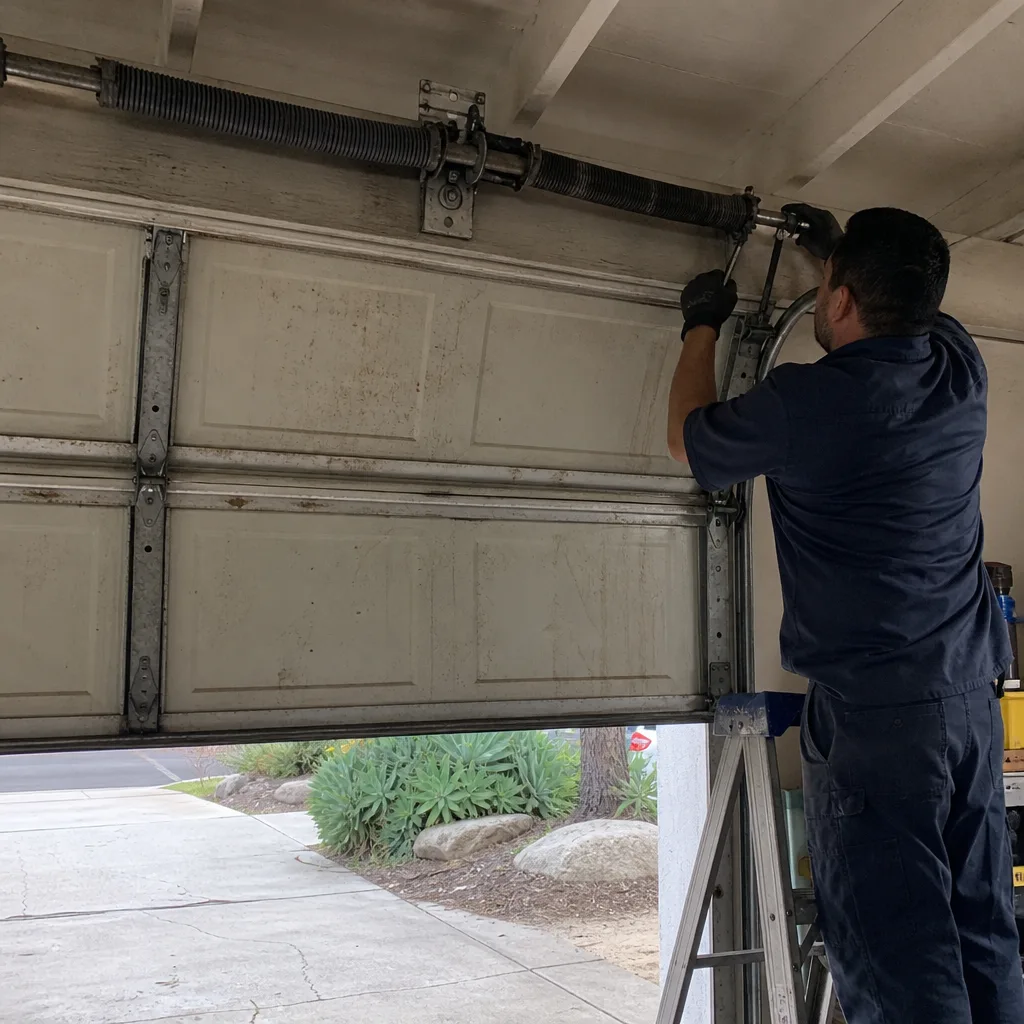 Before
 After
After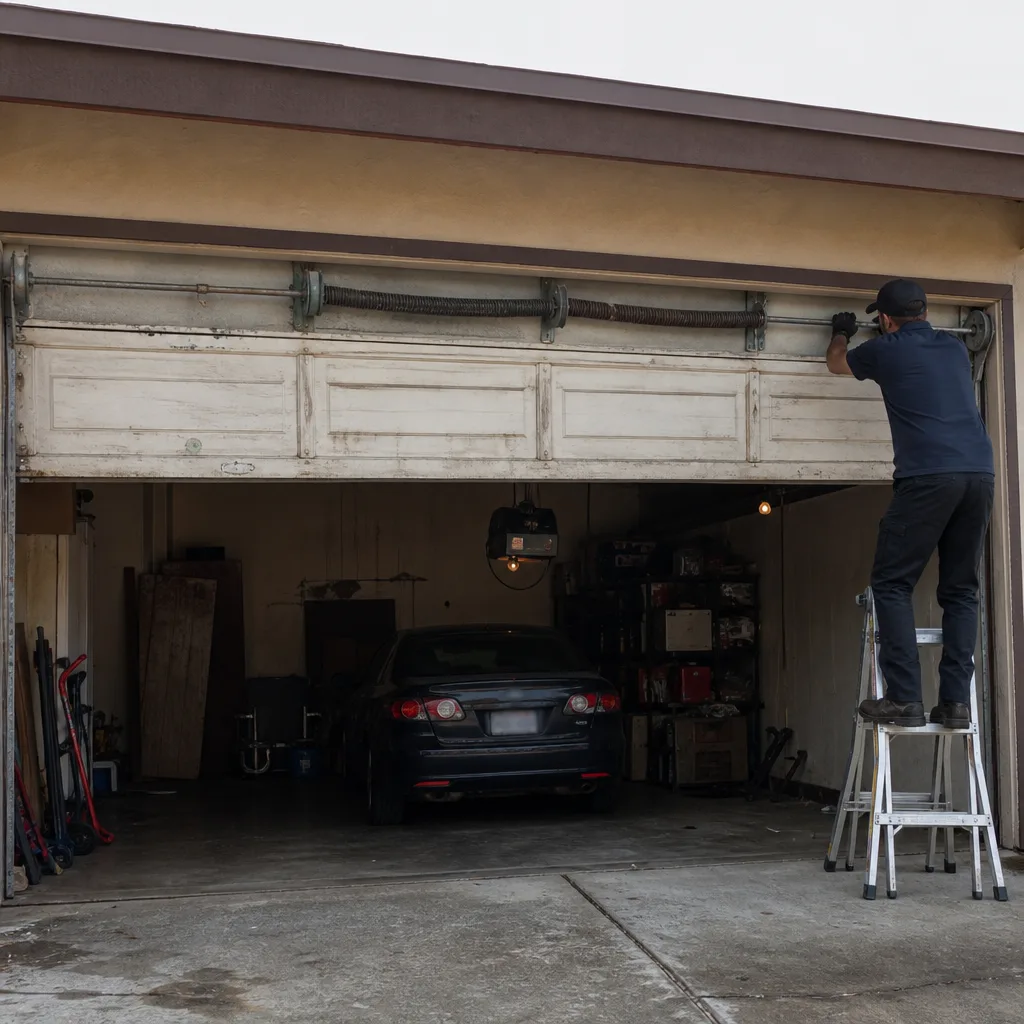 Before
 After
AfterDIY vs Professional Garage Door: The Poway Homeowner’s Decision Guide
A torsion spring on a standard residential garage door stores somewhere between 100 and 300 foot-pounds of torque, depending on the door’s weight. That’s not a reason to panic. It’s a reason to know exactly what you’re doing before you touch the winding cone, because the people who get hurt are the ones who looked up a video on Saturday morning and figured it was probably fine. In Poway, where nearly every home has an attached garage and summer temperatures bake springs to failure faster than coastal areas, this decision comes up constantly. This guide draws an honest line between what you can safely handle yourself and what deserves a phone call, without talking down to anyone.
Quick Answer
Most garage door maintenance is genuinely DIY-friendly: lubrication, weather seal replacement, photo-eye alignment, and opener remote programming are safe for a competent Poway homeowner with basic tools. But torsion spring replacement, cable work under tension, and track realignment carry injury risk and hidden liability costs that make professional service the only sensible choice. When in doubt, the rule is simple: if the component is under tension and a failure sends metal flying toward your face, call someone who does this every day. Otto’s Garage Door home has been the name Poway calls since 2004.
Table of Contents
- The Honest Breakdown: What You Can Do vs. What You Shouldn’t
- The Physics of a Torsion Spring: Why This Specific Risk Is Different
- Real Cost Comparison: DIY Parts vs. Professional Labor in Poway
- The Hidden Costs Nobody Tells You About
- California Liability and Insurance: What Happens If Your DIY Fix Fails
- The Three-Question Decision Tree
- Why Poway’s Climate Changes the Math
- Common Mistakes to Avoid
- When to Call a Professional
- Frequently Asked Questions
- The Bottom Line
The Honest Breakdown: What You Can Do vs. What You Shouldn’t
Most websites either tell you to never touch your garage door or imply that every repair is a weekend project. Both are wrong. We’ve been fixing doors in Poway since 2004, and we’d rather give you the straight answer: some of this stuff is genuinely simple, and we’re not going to pretend otherwise just to run a service call. Here’s the honest list.
Things a competent Poway homeowner can safely handle:
- Lubricating rollers, hinges, and springs. Use white lithium grease on metal parts and a silicone spray on nylon rollers. This takes fifteen minutes and should be done every six months in Poway’s dry heat, which sucks moisture out of metal and accelerates wear.
- Replacing the bottom weather seal. The rubber strip at the bottom of the door cracks and hardens in Poway summers. A replacement costs around $15 to $25 at any hardware store and slides out of the aluminum retainer with a pair of pliers.
- Aligning photo-eye sensors. If your door reverses when closing and the sensor lights are blinking, the problem is usually just alignment. Loosen the wing nut, adjust the bracket until the light goes solid, tighten it back down. Five minutes, zero tools beyond a screwdriver.
- Programming remotes and keypads. Chamberlain, Genie, and Craftsman openers all have straightforward learn-button sequences. Your opener’s manual is online if you lost the paper copy, and this involves zero mechanical risk.
- Tightening loose hardware. The tracks and hinges vibrate constantly, and bolts work loose over time. A socket set and ten minutes gets most of these snug again. Just don’t touch anything connected to a spring under tension.
Things that require professional handling, no exceptions:
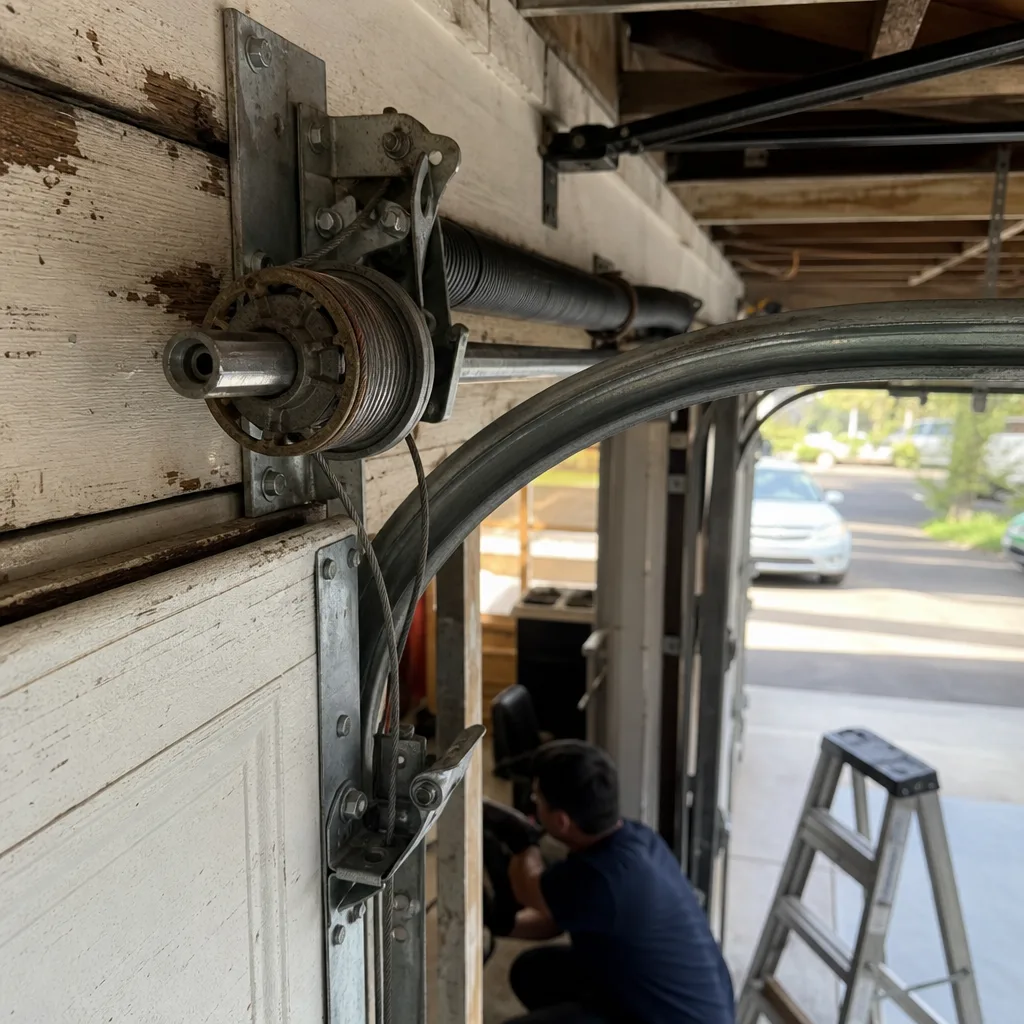
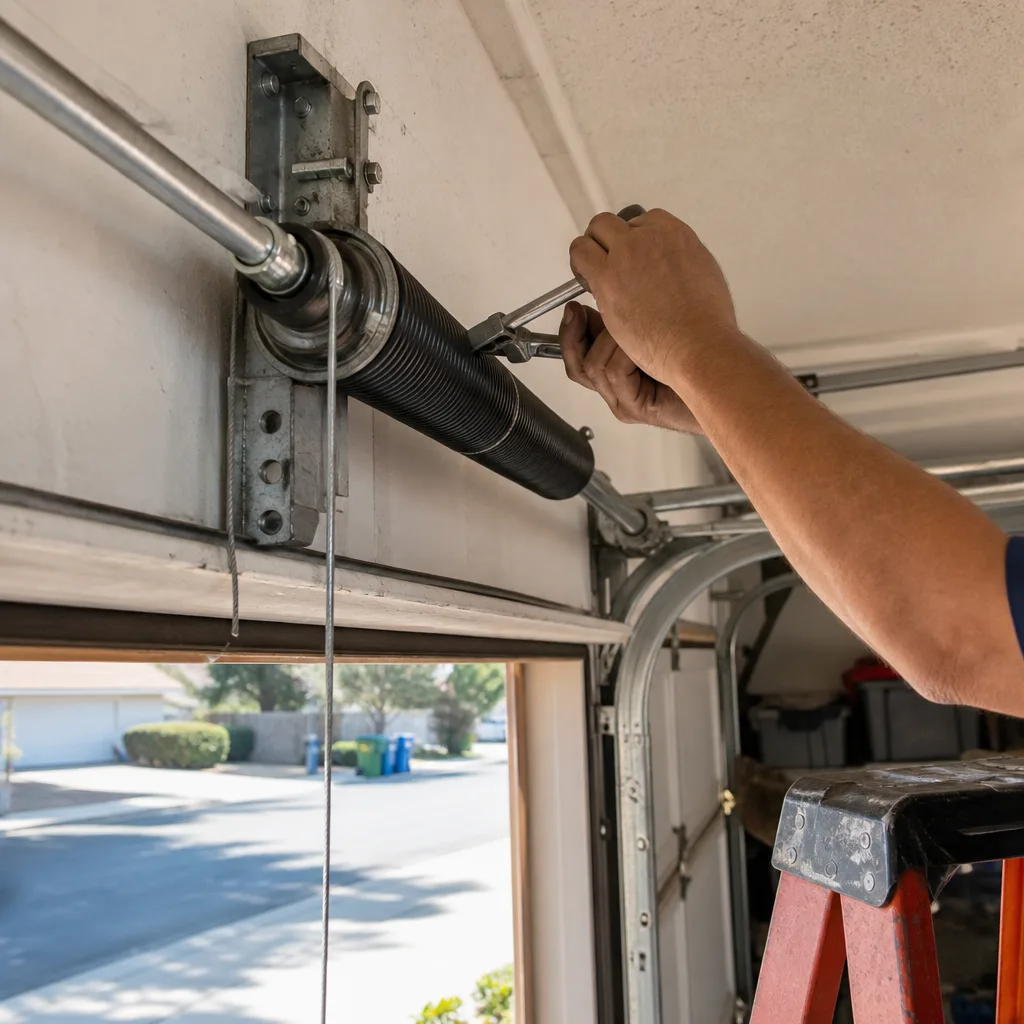
- Torsion spring replacement. This is the one that sends people to the ER. The spring is wound under enormous mechanical tension, and if the winding bar slips, it becomes a projectile moving faster than you can react. A door is 200 pounds riding on two springs. Respect it.
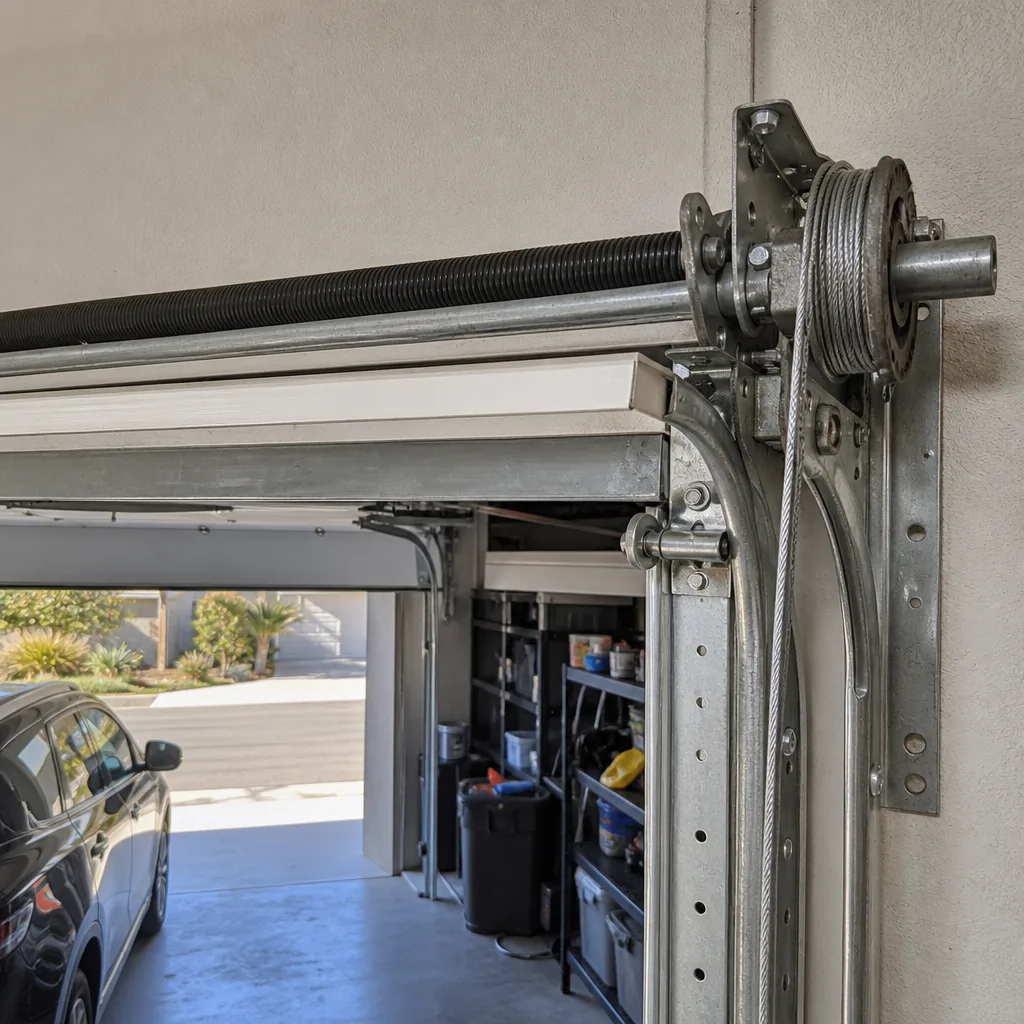
- Cable replacement. The cables run alongside the door and connect to the bottom brackets. When they fray or snap, the door can drop with full force on anyone or anything underneath. Replacing a cable requires releasing and re-tensioning the spring system, which puts you back in the danger zone.
- Track realignment under tension. If the door is binding in its tracks, the problem is often a roller that jumped out or a track that shifted. But the door is still under spring tension, and removing it from the track without properly de-tensioning the spring is how garages get damaged and homeowners get hurt.
- Full door replacement. This isn’t just heavy work. A new door has to be balanced to the spring system, and the springs have to be wound to the precise number of turns specified for that exact door weight. Too few and the opener burns out straining against it. Too many and the door rockets up. Garage Door Installation in Poway is not a weekend project, and the warranty only holds if it’s done right.
The line is simple: everything safe to DIY involves cleaning, adjusting, or replacing a part that isn’t holding stored mechanical energy. Everything else involves tools that can kill you if they slip. That’s not gatekeeping. That’s telling you what the door is actually doing.
The Physics of a Torsion Spring: Why This Specific Risk Is Different
Most home repair risks are easy to understand because you can see them. A ladder can tip. A saw can cut. A live wire can shock. But a garage door spring looks harmless sitting up there above the door, a coiled piece of steel with a quiet job. It isn’t until you understand what’s inside it that the respect kicks in.
A torsion spring works by storing mechanical energy. When the door closes, the spring winds up. When the door opens, the spring unwinds and does the actual work of lifting the door, with the opener just guiding it along. That’s why a working spring lets even a weak opener lift a 200-pound door: the spring is doing the heavy lifting, not the motor. It’s also why when the spring snaps, the door becomes dead weight that can crash down.
Here’s the specific failure mode that makes torsion spring work uniquely dangerous: the spring is wound using two steel winding bars inserted into a cone at the end. You wind one quarter-turn at a time, and the spring holds that tension until you move to the next quarter-turn. If the bar slips out of the cone while the spring is partially wound, that stored energy has to go somewhere. It goes into the bar, which becomes a projectile moving at roughly 100 miles per hour in a space the size of your head and shoulders. You are standing, inescapably, exactly where that bar travels.
This is not like a table saw, where careful technique and safety gear meaningfully reduce the risk. This is a mechanical system where one slip, one moment of distraction, one bar that isn’t fully seated in the cone, and there is no time to react. The people who get hurt are not idiots. They’re homeowners who are reasonably handy, reasonably careful, and got unlucky in a situation where luck was their only real margin for error. If you want to see what’s left on your springs before any of this is relevant, we’ll tell you plainly, the same way we count spring cycles on every service call. I count spring cycles the way you count tire miles, and I’ll tell you what’s left on yours.
Real Cost Comparison: DIY Parts vs. Professional Labor in Poway
Let’s put actual numbers on the table for the five most common garage door repairs in Poway, because the decision should be made with real math, not fear or pride. For a full breakdown of what drives these costs, see our Garage Door Cost Breakdown: The Poway Homeowner’s Reference for 2026. These are the ranges we see locally, and DIY parts costs reflect what you’d pay at a Poway hardware store or online retailer.
- Bottom weather seal replacement. DIY parts: $15-$30, 30 minutes. Professional cost: $75-$125 total. Verdict: DIY makes sense if the retainer is clean. If the aluminum retainer is bent or corroded, the pro is worth it.
- Lubrication service. DIY cost: $8-$15 for a can of white lithium grease and silicone spray, 20 minutes. Professional cost: $75-$100 for a full service that also includes tightening hardware and checking balance. Verdict: DIY, unless you’re already having another repair done.
- Photo-eye sensor replacement. DIY parts: $20-$40 for a new sensor pair, 45 minutes. Professional cost: $120-$180 including the part. Verdict: DIY if it’s just alignment, pro if the sensor itself is dead and you’re not confident with wiring.
- Cable replacement. DIY parts: $25-$50 for cables, but this job realistically requires special tools and the skill to de-tension and re-tension the spring. Professional cost: $150-$250 including both cables and re-balancing. Verdict: Pro. The parts cost looks deceptively low, but the risk-adjusted cost of doing this yourself is enormous.
- Torsion spring replacement. DIY parts: $60-$120 for a pair of springs online. Professional cost: $180-$340 in Poway for a pair of properly rated springs installed and balanced. Verdict: Pro. The spring itself is the cheapest part of this job. The labor cost is paying for the expertise to wind it safely.
Notice the pattern. The safe DIY jobs have low parts costs and low pro costs. The dangerous DIY jobs have low parts costs and moderate pro costs. The difference between what you’d pay for parts and what you’d pay a professional is often under $200, which is the cheapest insurance you’ll ever buy against a projectile wrench to the face. If that lens is what you’re shopping through, our garage door repair guide covers the remaining questions on pricing and process.
The Hidden Costs Nobody Tells You About
The parts-versus-labor comparison is only half the picture. The other half is what happens when the DIY fix doesn’t hold, or when it creates a new problem, and suddenly you’re paying for a second service call on top of the parts you already bought. We’ve seen this enough times in Poway to know the pattern.
The second service call tax. You replace a spring with an online pair rated for the wrong door weight, or you wind the spring to the wrong number of turns. The door works for a week, then the opener starts straining and burning out its motor. Now you’re paying for a spring replacement and an opener replacement. The $100 you saved became a $400 additional expense. If the opener is straining, the problem is almost never the opener.
The door-damage tax. A door that falls because a cable failed can bend its own panels on the way down, can fold the track like a pretzel, and can break the opener arm. The official term for this is consequential damage, and it’s almost always more expensive than the original repair would have been.
The time tax. The thing about a garage door that doesn’t open is that your car is inside it. You’re taking PTO, borrowing a neighbor’s vehicle, canceling plans. A repair that takes a professional ninety minutes can eat an entire weekend of yours, and then still need the professional on Monday.
The injury tax. This one doesn’t show up on any invoice, but it’s the real reason we write this guide. Hospital copays, lost work days, and the stubborn shoulder that never quite works right again. Every single one of those costs more than the service call would have.
California Liability and Insurance: What Happens If Your DIY Fix Fails
Here’s a question almost nobody asks until it’s too late: if your DIY garage door repair causes property damage or injury, does your homeowner’s insurance cover it? The answer in California is complicated, and it’s worth understanding before you start turning a wrench.
In general, your homeowner’s insurance covers sudden and accidental damage to your home, including damage from a garage door failure. But insurance policies also contain an exclusion for damage caused by work that should have been performed by a licensed contractor. In California, garage door contractors working on projects over $500 in combined labor and materials are required to hold a C-61/D-28 license from the Contractors State License Board. When a homeowner performs work that requires a licensed contractor and that work fails, the insurance company can deny the claim on the grounds that the damage was caused by unlicensed work.
This gets especially relevant in Poway, where property values are high and a garage door failing catastrophically can mean damage to vehicles stored inside, walls, and even structural components if a heavy custom door comes down hard. The specific question an adjuster will ask is: was the spring or cable work performed by someone who was qualified to perform it? If the answer is no and the damage traces back to that work, you’re having a very unpleasant conversation with your insurance company.
We’re not saying this to scare you into calling us. We’re saying it because nobody else in this industry bothers to tell Poway homeowners this before they spend a Saturday afternoon on YouTube University. Otto’s Garage Door has a published license number and address any homeowner can verify before the truck arrives. The name on the van is the name on the invoice and the name on the license. That matters when the insurance company asks who did the work.
The Three-Question Decision Tree
Forget the long lists and the pros-and-cons charts. Here are three questions that tell you, in under two minutes, whether your specific situation is a DIY job or a call-Otto job. No judgment either way. We’d rather you fix what you can and call when you should than pay for things you didn’t need us to do.
- Does the component I need to touch store mechanical energy, and is that energy under tension right now? If the answer is yes - springs, cables, anything attached to either - this is a professional job. If the answer is no - seals, sensors, lubricant, remote programming - keep going to question two.
- If this goes wrong while I’m working on it, what is the worst thing that happens? My answer has to be “I waste some time” or “I spend a little money.” If the answer is “a piece of metal hits me in the face at highway speed” or “a 200-pound door falls on my car,” this is a professional job. The difference between those answers is the entire decision.
- Do I have exactly the right tools, and do I know the exact torque or tension specification? Garage door springs aren’t one-size-fits-all. They’re rated by door weight, door height, and drum type. If you’re guessing at the spec, you’re guessing at the repair. And guessing plus stored mechanical energy is a bad combination.
If you answered “no” to all three, call someone. If you answered “yes” to all three and the job is on the safe list from earlier, we’ll tell you exactly how to do it well. That’s how we’ve treated Poway homeowners since 2004, and it’s why they keep calling back when the job is bigger than they expected.
Why Poway’s Climate Changes the Math
Garage door advice written for homeowners in Seattle or Chicago doesn’t always apply in Poway, and here’s why. Our climate is hot, dry, and sunny more days than not, and those three conditions accelerate certain failure modes in very specific ways.
Heat accelerates spring fatigue. Torsion springs are rated by cycle count, which is the number of open-and-close operations they’re engineered to survive. Standard springs are rated for about 10,000 cycles, which is roughly seven to ten years of typical use. But that rating assumes moderate temperatures. In Poway, where summer temperatures regularly push past 95 degrees in the garage and the metal expands and contracts daily, the actual lifespan of a standard spring is closer to five to seven years. That’s not a guess. We see it in every Poway neighborhood, from Green Valley to Old Poway, and the failure pattern is consistent.
Dry heat destroys weather seals. The rubber and vinyl seals on your door harden, crack, and shrink in Poway’s low humidity far faster than they would in coastal climates. A bottom seal that would last six years in Carlsbad might last three in Poway. Replacing it early keeps dust out of the garage, which matters here because we have plenty of dust.
Nylon rollers wear differently in heat. Nylon rollers are quieter than steel, but the nylon can become brittle in sustained high temperatures and crack. If you’re hearing a grinding noise from your door, check the rollers before you assume the opener is failing. Poway homeowners who don’t might replace a perfectly good opener and still hear the same noise.
None of this changes the basic DIY-versus-pro decision, but it does change the maintenance schedule. In Poway, you should lubricate every six months, inspect your springs annually, and replace weather seals the moment they start cracking. We lay out the full schedule in our Garage Door Repair Maintenance Checklist for Poway Homeowners. A little attention on the cheap stuff extends the life of the expensive stuff, and it means that when the spring finally does let go, you’ll have already gotten your money’s worth.
Common Mistakes to Avoid
- Using the wrong lubricant. WD-40 is a solvent, not a lubricant. It strips away whatever lubrication was there and leaves the metal dry. Use white lithium grease on metal components, not a penetrating oil. If in doubt, ask us, not the hardware store aisle.
- Winding a spring without the correct winding bars. Some people use screwdrivers or rebar in place of proper winding bars. Those tools bend, slip out of the cone, and become projectiles. This is the specific mistake behind most garage door injuries.
- Replacing one spring instead of both. If one spring has failed from metal fatigue, the other is on its last days. Replacing only the broken one means paying for labor twice, because the second spring will fail within months. Always replace both, and ask for springs rated for more cycles than the stock ones.
- Disconnecting the safety cable when working on extension springs. On older Poway garages with extension springs, the safety cable runs through the center of each spring to contain it if it snaps. If you remove that cable and the spring snaps, it becomes a 100-mph metal whip traveling the length of your garage. Leave the safety cable alone.
- Assuming the opener is the problem. In our experience, the majority of “opener problems” in Poway are actually spring problems, balance problems, or track problems. The opener is the weakest link, so it’s the first thing to fail when something else in the system is wrong. Diagnose the whole system before you replace the opener.
- Ignoring a slow-closing door. A door that closes faster than it used to is a warning sign that the springs are losing tension or have already broken. A door that drops the last foot is a door that will eventually not close at all, or close on something. This is a call-ahead-of-time situation, not a wait-and-see situation.
When to Call a Professional
You need a professional when the component you’re working on is under tension, when the failure mode is dangerous, or when the job requires tools and specs you don’t have on hand. Specifically: a snapped torsion spring, a frayed or broken cable, a door that’s come off its tracks, or a full door or opener replacement. These are not judgment calls. These are the jobs where the risk-adjusted math points overwhelmingly toward a pro, and where a Poway homeowner who tries to save a couple hundred dollars can end up with a much larger bill, a denied insurance claim, or worse. If you’re not sure which category your problem falls into, our garage door opener guide explains what’s actually wearing out and what isn’t. Otto’s Garage Door offers free estimates in Poway, and a live person answers the phone around the clock. Call (858) 330-1549 and tell us what’s happening. We’ll tell you honestly whether it’s a job for you or a job for us, and we’ll quote it before we ever roll a truck.
Frequently Asked Questions
Professional torsion spring replacement in Poway typically costs between $180 and $340 for a pair of springs, installed and balanced to your specific door weight. DIY spring parts cost $60 to $120 online, but the risk of injury and the likelihood of incorrect spec installation make the professional route the only sensible choice for this repair. Call (858) 330-1549 for an exact quote on your door, and Otto will hold that number when he gets there.
You can physically do it, but the risk profile is unlike any other home repair: one slip of the winding bar turns a 16-inch steel rod into a projectile moving faster than a major-league fastball, and you’re standing exactly where it travels. This is the repair where our honest answer is always: don’t. The money you save is not worth the chance of losing a hand, an eye, or worse. Call (858) 330-1549 and we’ll have it done safely.
Lubricating hinges, rollers, and springs, replacing the bottom weather seal, aligning photo-eye sensors, and programming remotes and keypads are all safe and manageable for a competent homeowner with basic tools. These jobs involve no stored mechanical energy and have failure modes that are merely inconvenient, not dangerous. For everything else, call a professional.
Look for a visible gap in the spring coil, which means the spring has physically separated and is no longer under tension. Listen for a sudden loud bang from the garage, which is the sound of a spring snapping. If the door feels unusually heavy when you manually lift it after pulling the release cord, or if it drops quickly when closing, the springs are likely failing or already failed. When any of these signs show up, call (858) 330-1549 for a free estimate.
Probably not, if the insurance company determines that the damage was caused by work that should have been performed by a licensed contractor. California requires a garage door contractor license for jobs over $500 in combined labor and materials, and policies commonly exclude damage resulting from unlicensed work. Using a licensed, insured Poway company like Otto’s protects both the repair and the claim.
Poway’s sustained high temperatures cause metal expansion and contraction that accelerates spring fatigue, cutting the typical lifespan of a standard torsion spring from about ten years to five to seven years in this climate. Dry heat also hardens rubber seals and makes nylon rollers more brittle. A six-month lubrication schedule and an annual spring inspection will help you catch problems before they strand you.
The Bottom Line
The DIY-versus-professional question on garage doors isn’t about how handy you are. It’s about whether the component holds stored mechanical energy and what happens if it releases while you’re in the path. Weather seals, lubrication, and sensor alignment are honest DIY jobs that any Poway homeowner can handle. Springs, cables, and track work are professional jobs with consequences that extend beyond the repair itself, reaching into your insurance coverage and your physical safety. When the job is on the line, call someone whose name you can verify and whose work carries a written 90-Day Done Right Promise. That’s the whole decision, and now you can make it with clear eyes.
Call Otto’s Garage Door at (858) 330-1549 for a free estimate in Poway. The price is quoted and agreed before any work starts, and the same person who answers the phone is the one who shows up.
Written by Otto Reinhardt, Owner at Otto’s Garage Door, serving Poway since 2004.